Of the 200 SEO agencies we reviewed, 133 advertised AI-search services on their websites. That’s roughly two in three.
Adding AI search to a service list is one decision. Explaining why a client should buy it is another. Across the websites reviewed, we looked at how agencies describe the work, connect it to client needs and give prospects a way to get started.
Watch the key findings in this four-minute video, or read on for the full analysis and agency examples.
Who we studied
We selected 200 SEO agencies from non-sponsored Clutch listings, drawing at random within region and employee-size groups.
We focused on agencies with 2–249 employees, giving more space to the two smaller size groups.
- 2–9 employees80 agencies
- 10–49 employees80 agencies
- 50–249 employees40 agencies
The study spans seven regional groups, with 150 of the 200 agencies based outside the United States.
Where agencies promote their AI-search services
Among the 133 agencies offering AI search, 99 had a dedicated service page and 92 promoted it on their homepage. Only four made AI search their opening homepage message. These placements overlap: the same agency can have a service page, promote it on the homepage and lead with it in the headline.
How prominently AI search appears
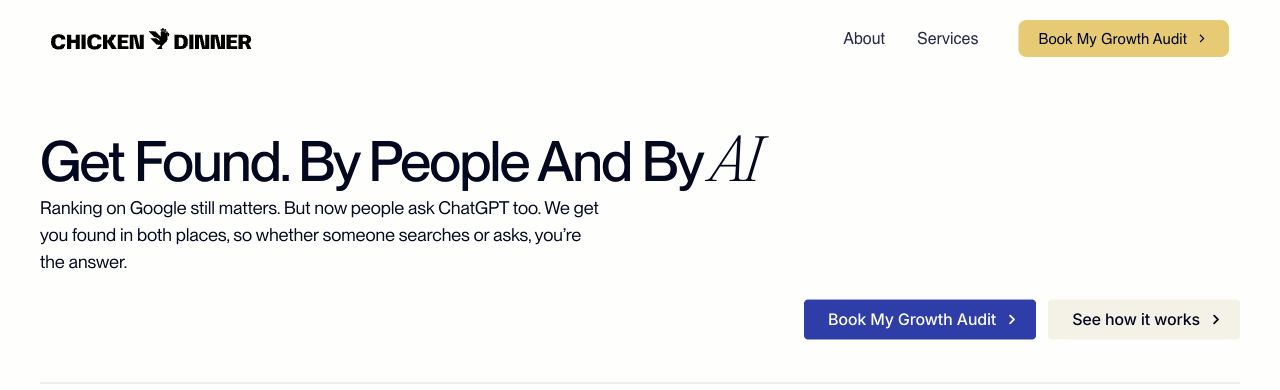
Australian growth marketing agency Chicken Dinner combines SEO and AEO on one service page. Its opening paragraph names Google and ChatGPT together. Visitors can book an audit or read how the work happens. The dedicated page gives the offer room for both an explanation of its scope and a next step.
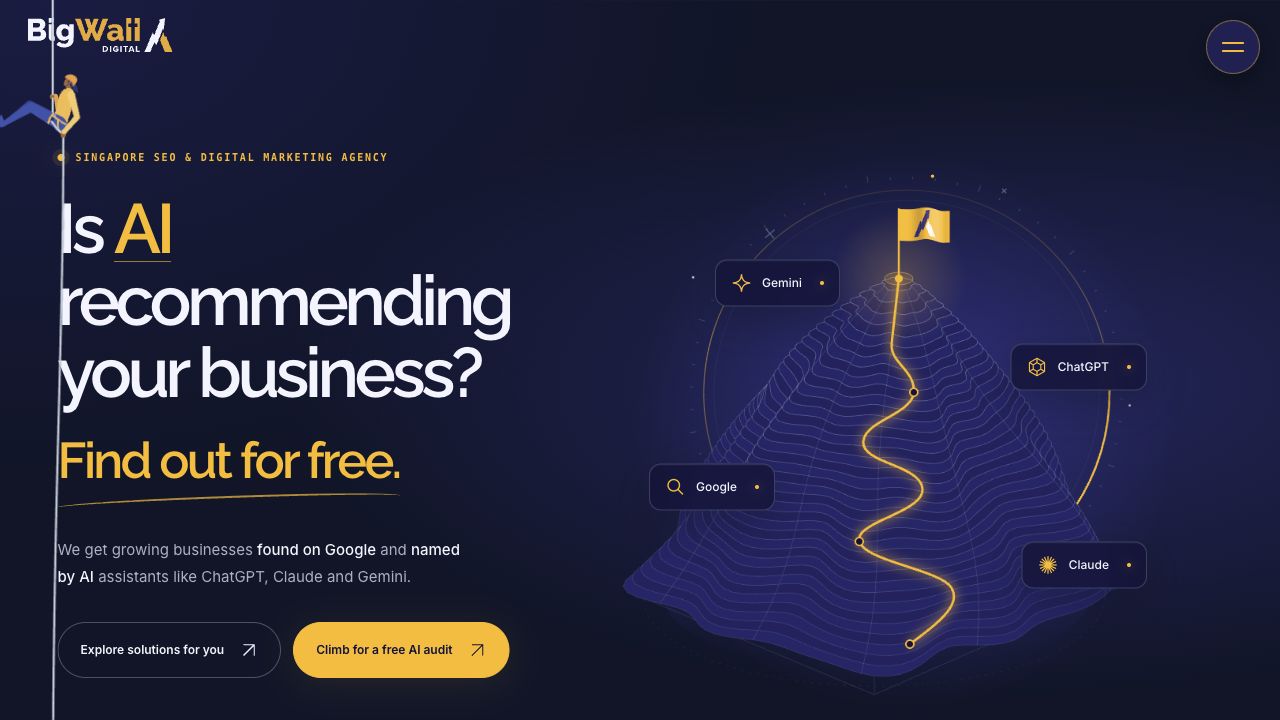
Singapore agency Big Wall Digital makes AI recommendations its opening homepage message, followed by a free audit invitation. A prospect can engage with the AI-search offer immediately, before browsing the agency’s service pages.
How agencies name AI search: AEO, GEO and mixed labels
Of the 133 offer pages, 78 led with one clear AI-search name, with GEO the most common. The chart breaks down those 78 pages. Another 27 gave several names equal prominence, while 20 led with SEO.
78 pages led with one AI-search name
Survey findings vary, too. GEO led among 342 industry readers surveyed by Fractl and Search Engine Land (42%), while “AI Search Optimisation” topped Koozai’s UK marketing terminology study of 160 respondents (32%).
Re:signal leads with GEO and names its audience, ecommerce brands, in the same headline. The opening copy then spells out generative engine optimisation.

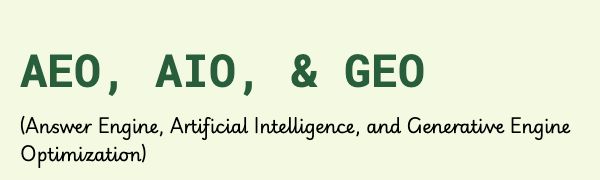
New Orleans digital marketing agency Online Optimism puts AEO, AIO and GEO in one heading and expands them directly underneath. Further down, it lists other names readers might search for, including AI SEO and LLMO.
What agencies promise their AI-search clients
124 of 133 agencies promote visibility in AI answers, while 49 explicitly connect the service to leads, sales, bookings or other commercial outcomes.
Visibility leads the sales pitch
62 of the 133 agencies name a sector or business model, such as ecommerce, SaaS or healthcare, including agencies serving several sectors.
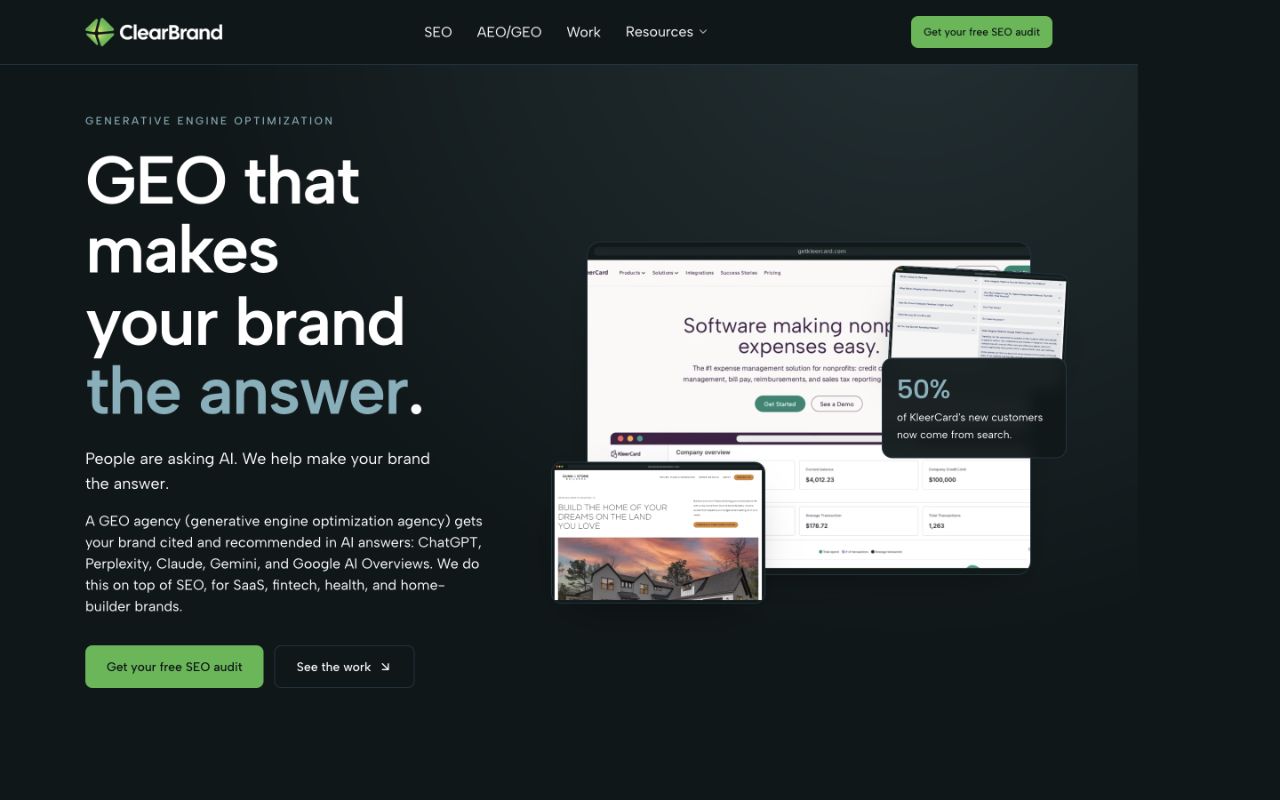
For SaaS, fintech, health and home-builder clients, ClearBrand promises to make their brand the answer, then explains that promise as being cited and recommended across AI tools.
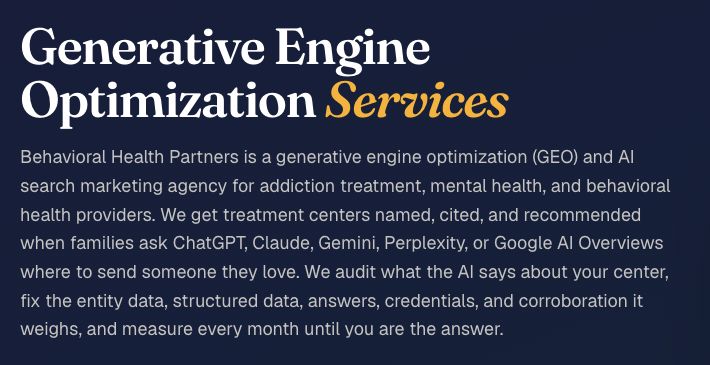
Treatment-center marketing specialist Behavioral Health Partners frames its promise around families asking AI where to seek care, making the audience and decision explicit.
How agencies use audits to start client conversations
An audit gives a prospective client a review of where their website or brand stands and what could be improved. An SEO audit examines performance in traditional search. AI-search audits check website readiness for AI tools, brand visibility in AI answers, or both. Agencies offer these reviews as a way for prospects to explore the work before committing to a wider engagement.
SEO audits were more common: 68 of the 200 agencies offered an SEO audit, compared with 45 offering an AI-search audit. 27 offered both. We counted audits that a visitor could request, run or buy before becoming a client, rather than reviews available only within paid client work.
Audits available before becoming a client
Expert reviews, audit requests and automated tools
Of the 45 agencies offering an AI-search audit, 19 described an expert-reviewed assessment and eight advertised an automated audit tool. The other 18 invited visitors to request or book an audit, without specifying whether the result would be prepared by a person or generated by software.
How agencies offer AI-search audits
We verified instant previews from two tools; outputs from the other six were not verified. An audit request form and an automated result are different experiences: one starts a review, while the other gives the visitor something to inspect immediately.
How an audit offer becomes a prospect’s first report
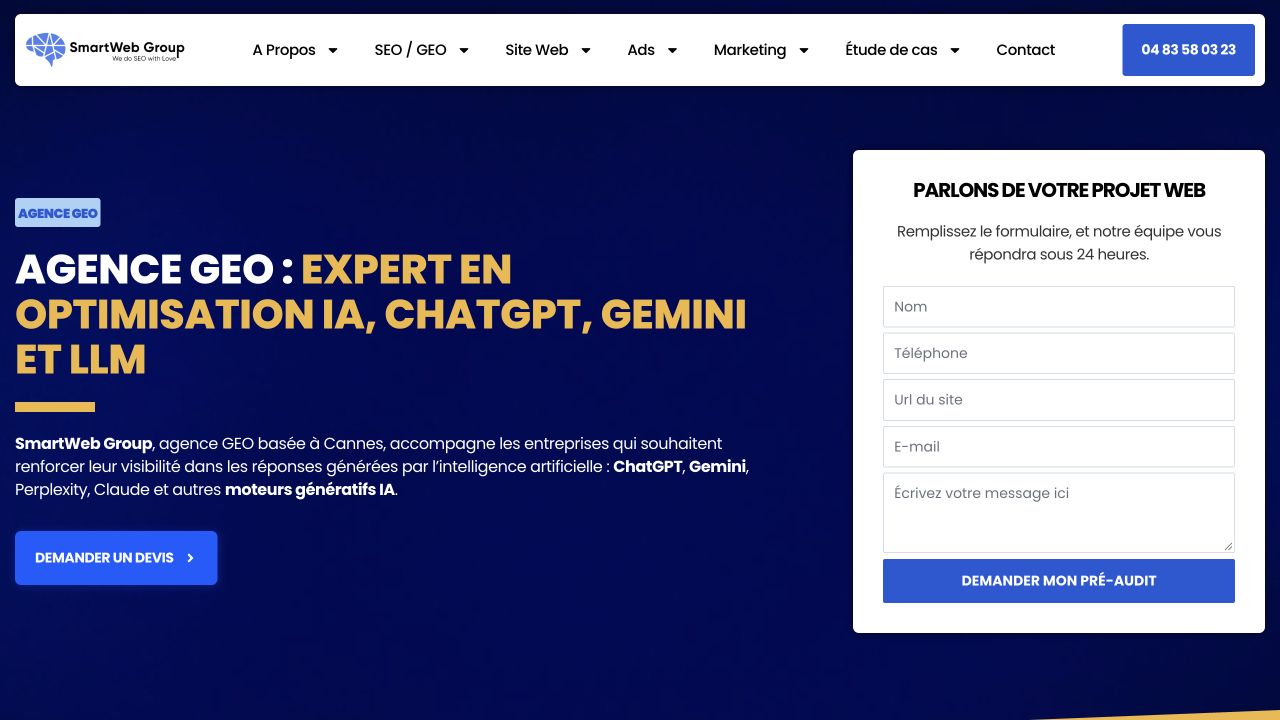
On its French-language GEO service page, SmartWeb Group invites visitors to request an audit. The button says “Demander mon pré-audit”, meaning “Request my preliminary audit”. Visitors provide their name, phone number, website, email and message, and the page promises a reply within 24 hours.
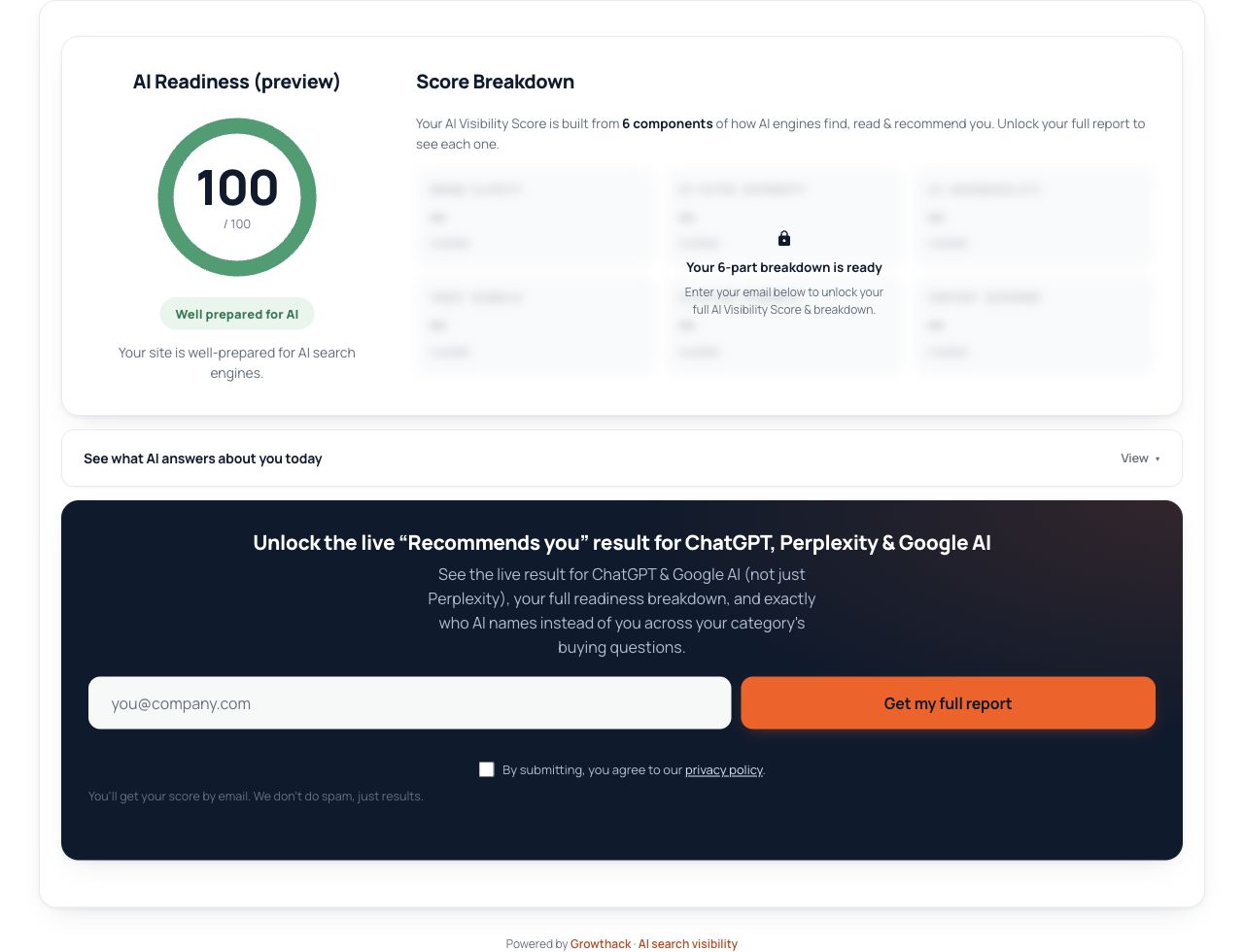
Organic growth agency Growthack gives the visitor an automated preview before asking for an email. Our test returned a readiness score, while the detailed breakdown remained behind an email form. The preview shows what a prospect can unlock. The score is the tool’s output, not an independently verified measure of AI visibility.
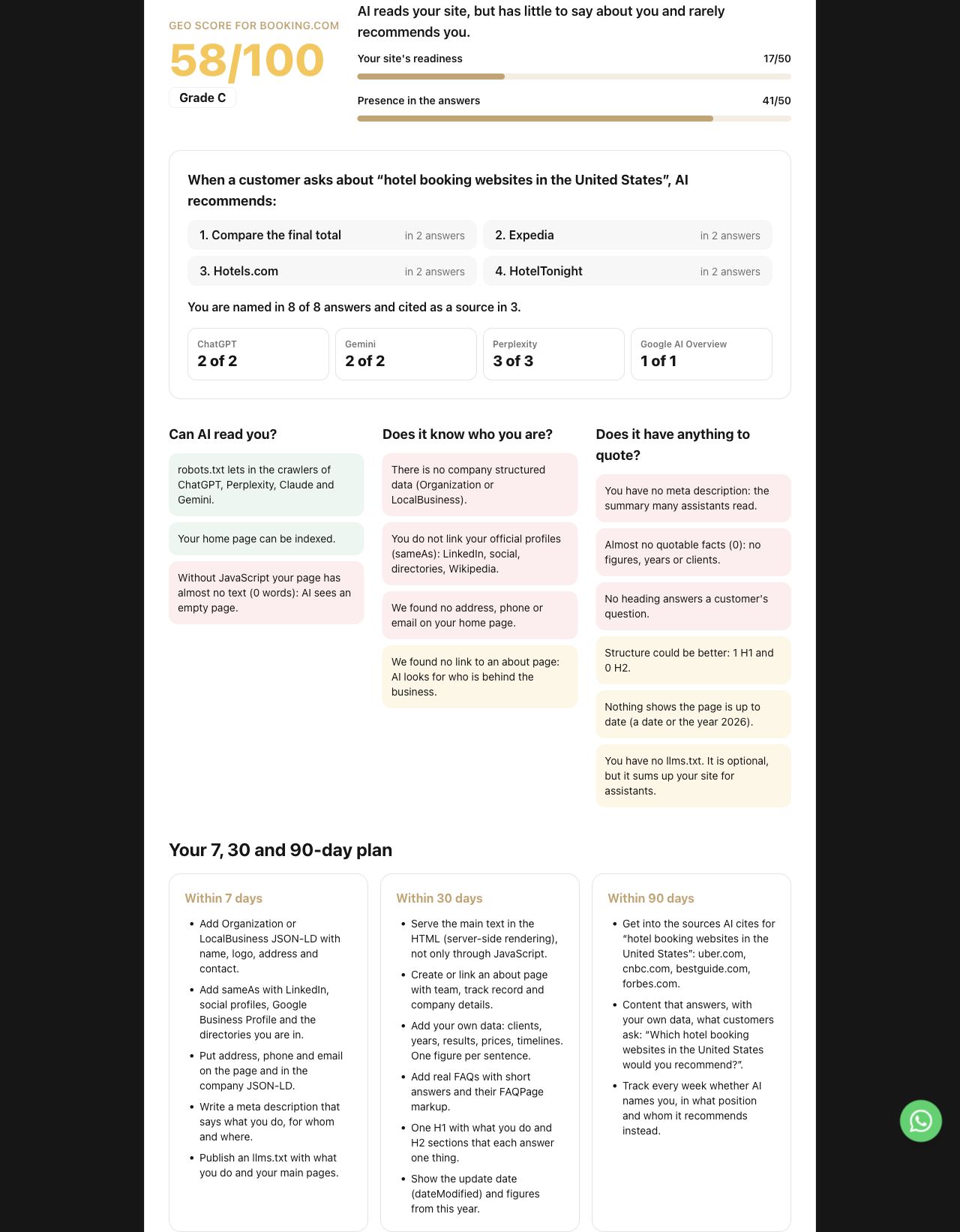
Spanish digital marketing agency iSocialWeb shows a fuller result before asking for contact details. We tested Booking.com for “hotel booking websites in the United States”. Its GEO audit separates page readiness from presence in AI answers and provides a 7-, 30- and 90-day plan. In this run, the tool reported Booking.com in all eight answers returned. The example shows the report’s format; individual findings still need review.
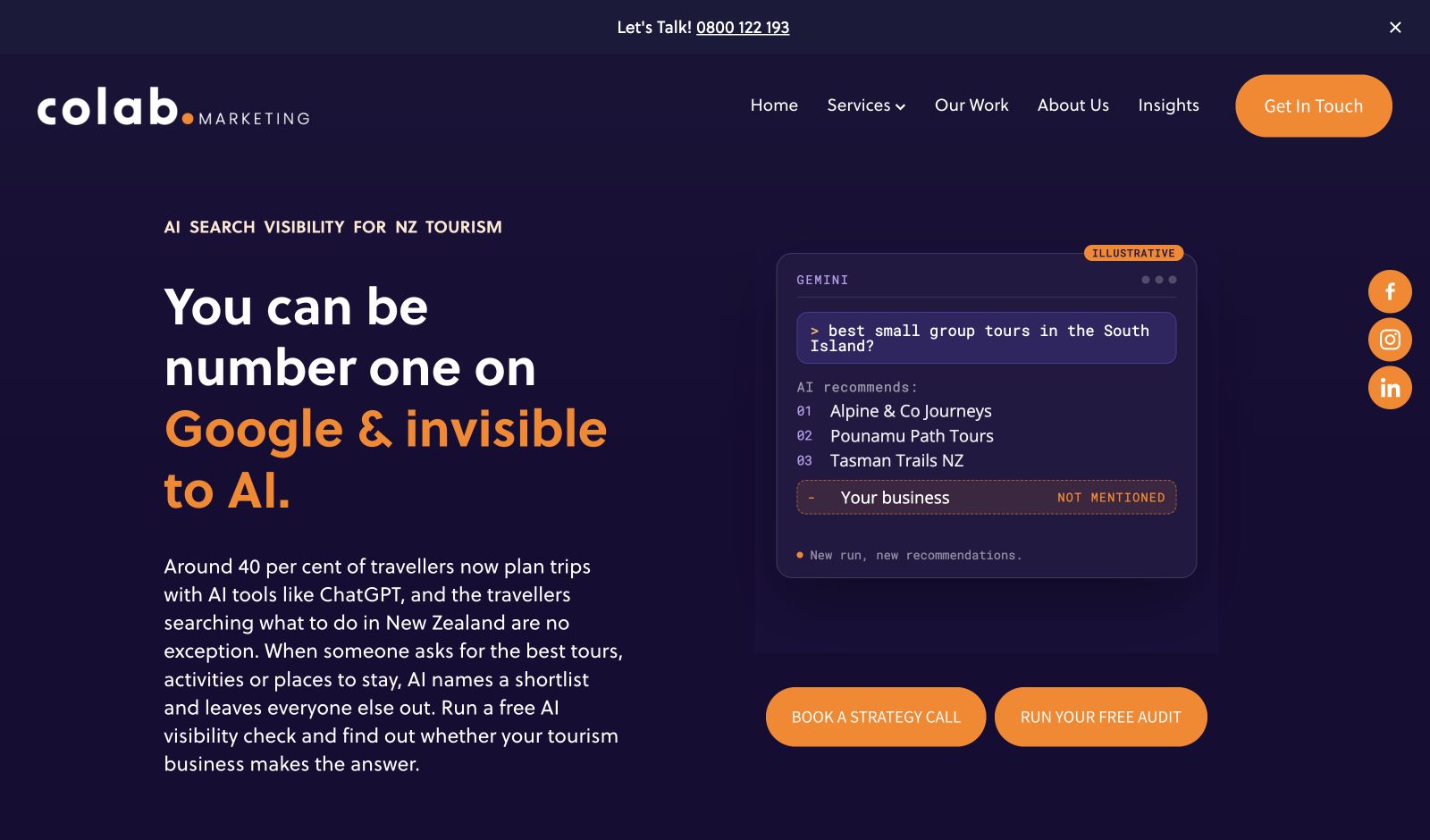
New Zealand agency Colab Marketing uses AI Page Ready, our AEO audit tool, to offer an AI-search visibility check for tourism businesses. Its page connects the audit to a specific buying decision: whether travellers asking AI about tours and experiences will be shown the operator’s name. The offer fits the audience before the visitor enters a URL.
We ran Colab’s audit for Stray Travel, a small-group tour operator in New Zealand and Southeast Asia. The AI Readiness Audit tab shows the page’s overall score and category breakdown. Switch to AI Search Visibility to see how Stray appears across five travel questions in ChatGPT and Gemini, alongside competing operators. In this run, Stray appeared in two of the ten answers, giving the agency specific gaps to discuss.

Stray Travel: Adventure Tours in NZ & Southeast Asia
Section Scores
The overall score is a weighted average of the individual section scores, based on the relative impact each section has on AI SEO.
The opportunity is to give prospects a useful assessment
An audit can make the service more tangible: show a business where it appears, which questions it misses and what could be improved. The opportunity is to provide an assessment worth discussing, rather than simply adding another form or score.
For agencies, the useful benchmark is what the prospect can learn from the report. State what was checked, show the findings behind the score and suggest a relevant next step.
How AI-search services and promotion differ by agency size and region
The smallest agencies advertised AI-search services less often than the other two size groups. But among those offering the service, smaller agencies more often promoted it on their homepage and offered an audit to prospects. Larger agencies more often gave the service a dedicated sales page.
AI-search services were less common among the smallest agencies
About three in four agencies with 10–49 employees advertised AI search, compared with just under three in five with 2–9 employees. The largest group sat between them, so service availability did not rise consistently with agency size.
AI-search services by agency size
Larger agencies favoured dedicated pages; smaller agencies favoured homepage promotion
Among agencies offering AI search, 89% of the largest group had a dedicated service page, compared with 67% of the smallest. Homepage promotion ran the other way: 78% of the smallest group promoted the service there, compared with 61% of the largest.
Service pages and homepage promotion by agency size
Smaller agencies more often offered an audit as a first step
Nearly half of the smallest agencies offering AI search let prospects request, run or buy an AI-search audit before becoming a client. In the two larger groups, that figure was about one in four.
AI-search audits by agency size
How AI-search offers vary by region
AI-search services appeared on 84% of the UK and Ireland websites and 80% in Continental Europe, compared with 60% in the United States and 50% in South and Southeast Asia. Among agencies offering AI search, 83% in the US promoted it on their homepage, compared with 54% in Continental Europe.
| Region | Offers AI search | Dedicated page | Homepage promotion | AI-search audit |
|---|---|---|---|---|
| United States | 60%30/50 | 73%22/30 | 83%25/30 | 40%12/30 |
| Canada | 70%14/20 | 71%10/14 | 79%11/14 | 36%5/14 |
| UK and Ireland | 84%21/25 | 86%18/21 | 76%16/21 | 38%8/21 |
| Australia and New Zealand | 68%17/25 | 76%13/17 | 53%9/17 | 29%5/17 |
| Continental Europe | 80%28/35 | 79%22/28 | 54%15/28 | 32%9/28 |
| South and Southeast Asia | 50%15/30 | 73%11/15 | 80%12/15 | 20%3/15 |
| Latin America, Middle East and Africa | 53%8/15 | 38%3/8 | 50%4/8 | 13%1/8 |
United States
- Offers AI search
- 60%30/50
- Dedicated page
- 73%22/30
- Homepage promotion
- 83%25/30
- AI-search audit
- 40%12/30
Canada
- Offers AI search
- 70%14/20
- Dedicated page
- 71%10/14
- Homepage promotion
- 79%11/14
- AI-search audit
- 36%5/14
UK and Ireland
- Offers AI search
- 84%21/25
- Dedicated page
- 86%18/21
- Homepage promotion
- 76%16/21
- AI-search audit
- 38%8/21
Australia and New Zealand
- Offers AI search
- 68%17/25
- Dedicated page
- 76%13/17
- Homepage promotion
- 53%9/17
- AI-search audit
- 29%5/17
Continental Europe
- Offers AI search
- 80%28/35
- Dedicated page
- 79%22/28
- Homepage promotion
- 54%15/28
- AI-search audit
- 32%9/28
South and Southeast Asia
- Offers AI search
- 50%15/30
- Dedicated page
- 73%11/15
- Homepage promotion
- 80%12/15
- AI-search audit
- 20%3/15
Latin America, Middle East and Africa
- Offers AI search
- 53%8/15
- Dedicated page
- 38%3/8
- Homepage promotion
- 50%4/8
- AI-search audit
- 13%1/8
“Offers AI search” uses all agencies reviewed in each region; the other percentages use only agencies offering AI search.
AI search is common. Here’s where agencies can differentiate.
Client interest is growing: in AgencyAnalytics’ 2026 survey of 494 agency professionals, 66% reported increased demand for AI-search services. In our review, 133 of 200 SEO agencies already advertised them.
Offering the service alone gives prospects little reason to choose one agency over another. The opportunity is to make the offer more specific: connect visibility to a client’s business goals, explain what the work includes and give prospects an audit worth discussing.
Make visibility relevant to the buyer
124 agencies promise AI visibility, but only 49 connect it to commercial outcomes. Explain what being found could mean for your clients, such as product discovery, enquiries or bookings, and support that promise with evidence.
Explain what clients receive
Whether you call it AEO, GEO or AI search, describe the work you’ll do and what the client gets. For example, identify the questions their buyers ask AI, check whether their brand appears, and explain which content you’ll improve.
Give prospects an audit worth discussing
Only 43 of the 133 agencies offering AI search advertise an AI-search audit. An audit can demonstrate your approach through specific findings and practical next steps.
How we conducted the study
In October 2026, we reviewed 200 SEO agency websites, randomly selected from non-sponsored Clutch listings across seven regional groups: 80 with 2–9 employees, 80 with 10–49 and 40 with 50–249, using Clutch’s reported sizes.
We checked service pages, homepage promotion, messaging and audits available to prospects. An AI-search service had to explicitly offer visibility in AI-generated answers; using AI to deliver conventional SEO did not qualify.
The percentages describe the agencies reviewed, not the entire agency market.
The study covers agency websites, not their wider marketing strategy or the results it delivers.